
Study in Canada from Bangladesh: 2026 Guide
Explore Canadian colleges and universities, tuition, scholarships, study permits, work rules, and PGWP guidance for Bangladeshi students.
Explore this guide
Canada at a Glance
Main intakes
September (Fall) and January (Winter)
Institution requirement
Must be a Designated Learning Institution (DLI)
Study authorization
Study Permit (and TRV)
Provincial document
PAL / TAL (or CAQ for Quebec)
Work during studies
Up to 24 hours per week off-campus (conditions apply)
Currency
Canadian dollar (CAD)
Is Canada right for you?
Take a realistic look at your profile, budget, and goals before committing to the Canada process.
This may suit you if...
- You have transparent, verifiable funds meeting the CAN$22,895 (outside Quebec) requirement
- You understand the distinction between universities, colleges, and their respective PGWP rules
- You are prepared for rigorous English (or French) language testing
- You have a logical, documented study plan linking your past education to future goals
- You are selecting a DLI that specifically offers PGWP-eligible programs
Pause and compare if...
- You rely on unauthorized or excessive off-campus employment to fund your tuition
- You assume all colleges automatically grant open work permits
- You expect a guaranteed pathway to Permanent Residency (PR)
- You plan to bring a spouse while enrolling in an ineligible undergraduate/college program
- You submit fraudulent documents thinking they won't be verified by IRCC
Why choose Canada for your studies?
Understand the academic environment, co-op opportunities, and structured post-study pathways available across Canadian provinces.

Your choice should align with your academic readiness, financial capacity, and verifiable program outcomes.
Global academic recognition
Degrees from Canadian universities and colleges are highly respected worldwide.
Co-op education
Many programs integrate paid academic internships (co-ops) into the curriculum.
Clear regulatory framework
The DLI system and IRCC guidelines provide structured study and work rules.
Diverse provinces
Study options range from major urban centers to affordable regional communities.
Research opportunities
Strong funding in STEM, healthcare, and environmental sciences.
Post-Graduation Work Permit
Eligible graduates can apply for a PGWP, subject to current field and language rules.
Popular Courses and Study Areas
Computer Science & IT
Artificial intelligence, software engineering, and cybersecurity.
Engineering
Civil, mechanical, electrical, and aerospace engineering.
Business and Finance
Accounting, supply chain management, and MBA programs.
Healthcare & Nursing
Public health, health informatics, and registered nursing.
Environmental Sciences
Climate change, forestry, and sustainable energy.
Agriculture and Agri-Food
Food science, agribusiness, and sustainable agriculture.
Media and Design
Animation, graphic design, and digital media.
Education
Early childhood education and educational leadership.
Trades and Technology
Advanced manufacturing, robotics, and applied technology.
Research and Doctoral
Fully funded PhDs and specialized research programs.
Financial & Application Document Checklist
Important: Required documents differ by individual profile and circumstances. AdmissionArena does not provide legal or migration advice. Always use the official IRCC website to verify your specific study permit requirements.
Identity
- Valid passport
- Digital photograph
- National ID / Birth Certificate
Academic records
- Degree certificates
- Academic transcripts
- WES evaluation (if requested)
Testing & Language
- IELTS, PTE, or TOEFL scores
- GRE/GMAT (for specific Master's/PhDs)
Application & Study Permit
- Letter of Acceptance (LOA) from a DLI
- Provincial Attestation Letter (PAL) or TAL (if applicable)
- Quebec Acceptance Certificate (CAQ) (if studying in Quebec)
- Statement of Purpose (Study Plan)
Financial evidence
- Proof of CAN$22,895 (outside Quebec) for living costs
- Proof of first-year tuition payment or capacity
- Bank statements (past 4-6 months)
- Sponsor's tax documents and income proof
Medical & Background
- Upfront Medical Exam receipt (eMedical)
- Police clearance certificate
- Biometrics collection
Intakes and Preparation Timeline
Note: These phases serve as a general guide. Processing times for applications, PAL/TAL issuance, and visas vary significantly. Do not treat these as fixed timelines.
Phase 1: Research
- Check DLI list and PGWP eligibility
- Research universities vs. colleges
- Determine exact funding required
Phase 2: Prepare & Apply
- Take IELTS/PTE/TOEFL
- Prepare Study Plan and documents
- Apply for admission to selected DLIs
Phase 3: Acceptance & Attestation
- Receive Letter of Acceptance (LOA)
- Pay initial tuition deposit
- Obtain PAL/TAL or CAQ (if required)
Phase 4: Study Permit
- Complete Upfront Medical Exam
- Submit Study Permit application online
- Provide biometrics at VFS
- Receive passport request and travel
Indicative Cost of Studying in Canada
Total costs vary heavily by province, institution, program, and lifestyle. Do not imply that part-time earnings will cover the full cost of studying and living. International students must show unencumbered proof of funds.
Tuition (Undergraduate)
Tuition (College/Diploma)
Tuition (Postgraduate)
IRCC Proof of Funds (Outside Quebec)
Study Permit Fee
Want to estimate your exact costs?
Use our comprehensive Cost of Studying Abroad Calculator to build a personalized budget based on your specific degree, city, and lifestyle choices.
Open Cost CalculatorScholarships for Canada
Scholarships are highly competitive and rarely cover full tuition.
University Merit Scholarships
Entrance scholarships automatically assessed or applied for upon admission.
Graduate Research Funding
Funding packages for thesis-based Master's and PhD programs.
Provincial Awards
Specific scholarships funded by provincial governments (e.g., Ontario Trillium).
External & Private Scholarships
Third-party organizations offering targeted support.
Are you eligible for a scholarship?
Use our Scholarship Checker to find funding opportunities matching your academic profile.
Examples of established Canadian universities
Canada is home to world-class institutions across the country. Here are some established universities known for their academic excellence.
University of Toronto
Research, Engineering, Business
University of British Columbia (UBC)
Environmental Science, Tech, Arts
McGill University
Medicine, Law, Humanities
University of Waterloo
Computer Science, Co-op, Math
McMaster University
Health Sciences, Engineering
University of Alberta
Energy, Agriculture, AI
University of Calgary
Geoscience, Business, Innovation
Western University
Business (Ivey), Medicine
Dalhousie University
Marine Biology, Law, Medicine
Simon Fraser University
Communication, Computing, Co-op
University of Ottawa
Public Policy, Bilingual Programs
Concordia University
Fine Arts, Business, Engineering
Find Your Ideal Institution
To host international students, an institution must be a Designated Learning Institution (DLI). Use the official government database to search for providers.
Student Cities in Canada
Canada's diverse cities offer different lifestyles, living costs, and opportunities. Choose a location that matches your career goals and budget.
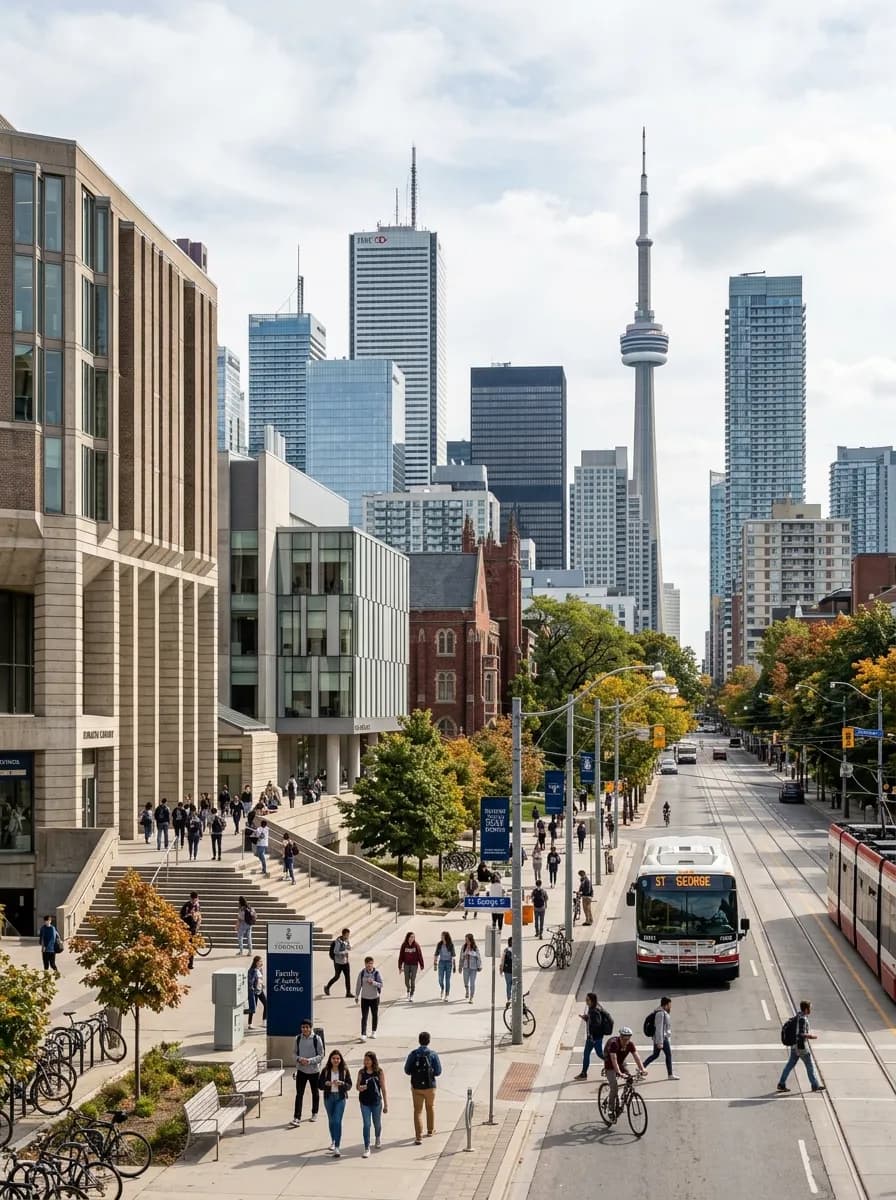
Toronto, ON
Canada's financial hub, exceptionally diverse and home to numerous top institutions.
Vancouver, BC
A coastal city known for mild weather, tech industries, and outdoor lifestyle.
Montréal, QC
A vibrant, bilingual cultural capital offering affordable tuition and high student satisfaction.
Ottawa, ON
The national capital, offering deep ties to government, tech, and public policy.
Calgary, AB
A rapidly growing, affordable city with strong roots in energy and tech innovation.
Halifax, NS
A historic coastal student city providing a welcoming community and lower living costs.
Edmonton, AB
Known for major research institutions and a strong economy driven by natural resources.
Work Rules for Students
Off-campus hours
Up to 24 hours per week during regular academic terms for eligible students.
Scheduled breaks
Full-time work permitted during officially recognized institutional breaks.
Co-op / Internships
Requires a separate co-op work permit if the work is an essential part of the program.
On-campus work
Unrestricted hours on the campus where you are registered, subject to conditions.
You must maintain full-time student status to be eligible to work. Working more than the allowed hours is a violation of your study permit conditions and can lead to deportation.
Health and Student Protections
Provincial Health Care
Access varies by province. Some offer provincial coverage without additional charges; others require private insurance.
DLI Framework
IRCC maintains strict oversight over DLIs to protect international students from fraud.
Employment Standards
International students receive the same minimum wage and workplace protections as Canadians.
Campus Support
Universities provide dedicated international student advising, academic help, and mental health resources.
Always arrange health insurance before arriving in Canada, as provincial coverage often has a waiting period.
Post-Graduation Work Permit (PGWP)
The PGWP allows international graduates to gain Canadian work experience. Eligibility and duration depend on your program type, length, and specific IRCC field-of-study rules.
Bachelor's, Master's, and Doctoral graduates generally qualify for up to a 3-year PGWP, provided they meet the new language proficiency rules (CLB 7). College graduates face stricter field-of-study restrictions aligned with labor shortages and require CLB 5.
Critical Verification
Do not assume your program offers a PGWP. Always verify your specific DLI and program on the IRCC website before accepting an offer.
Frequently Asked Questions
Essential information for Bangladeshi students planning to study in Canada.
What is a DLI?
Do all DLI programs qualify for a PGWP?
What is the new Proof of Funds requirement?
Can I bring my spouse with me?
How many hours can I work off-campus?
What is a PAL or TAL?
Are the PGWP rules changing?
Is the Student Direct Stream (SDS) still available?
Check official information
Study permit rules, PGWP eligibility, and requirements can change. Confirm the latest information through the official Government of Canada sources below.
Ready to Start?
Book a consultation to discuss your Canadian study plans.