
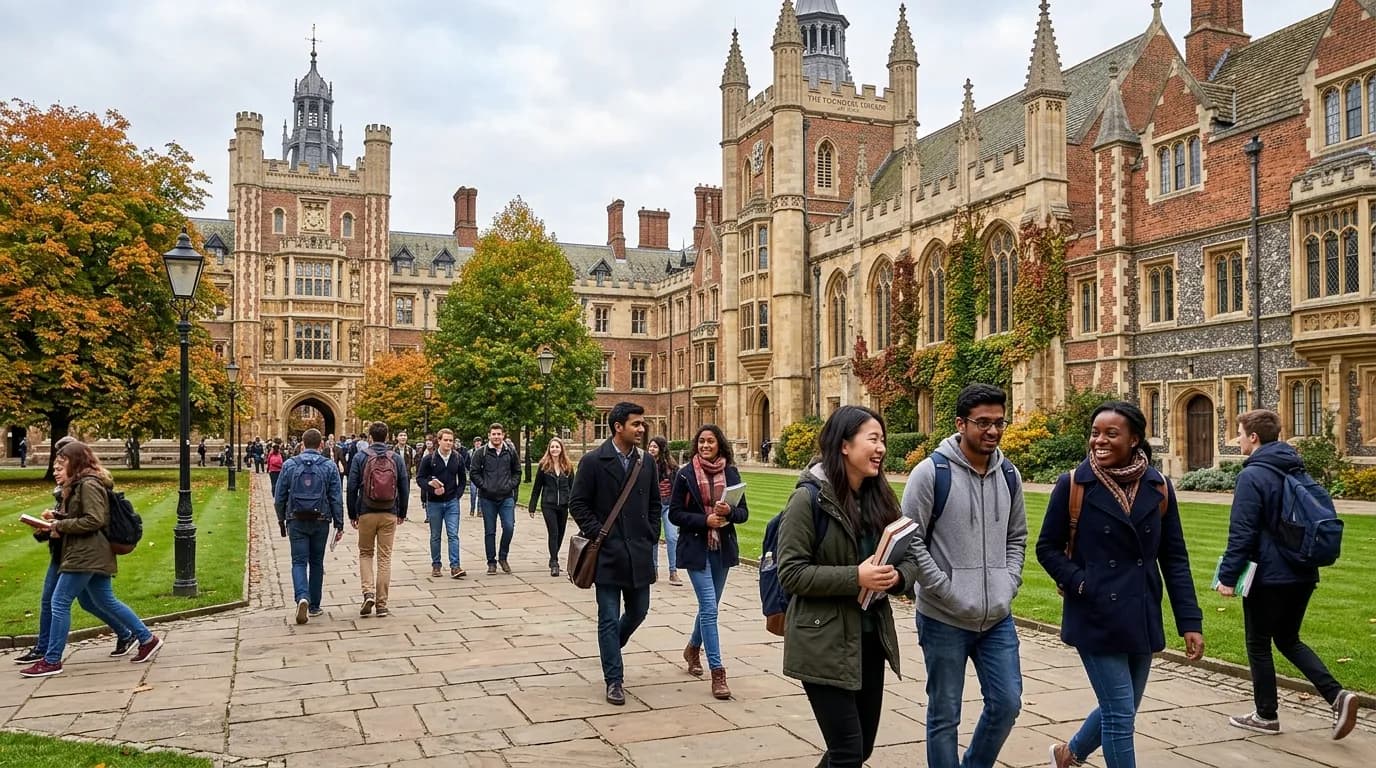
Study in the UK from Bangladesh
Fast-track your career with 1-year master's degrees, explore post-study work options, and navigate UK university admissions. Build your academic future in a globally respected education system.
Explore this guide
UK at a Glance
Main intakes
September (Main), January (Secondary)
Primary study visa
Student Visa (£558)
Healthcare Surcharge
IHS (£776/year)
Maintenance funds
£1,529/mo (London) or £1,171/mo (Outside)
Work while studying
Up to 20 hrs/week (degree level)
Currency
British Pound (GBP / £)
Is the UK right for you?
Take a realistic look at your profile and goals before committing to the UK admission process.
This may suit you if...
- You want to complete your master's degree in just one year
- You seek degrees from globally recognized and prestigious institutions
- You want a clear, structured post-study work route (Graduate visa)
- You prefer a destination with a large, established Bangladeshi community
- You want easy access to Europe and proximity to home compared to North America
Pause and compare if...
- You have a low budget, as UK tuition and living costs are consistently high
- You expect a guaranteed, automatic pathway to permanent residency
- You plan to bring dependents as a non-research master's student
- You intend to rely solely on part-time jobs to pay your tuition fees
- You struggle with intensive, independent study requirements in short 1-year programs
Why choose the UK for your studies?
Discover the unique advantages of the UK education system, from accelerated degrees to centuries of academic prestige.

The right choice depends on your preference for a fast-paced academic environment and clear career goals.
Shorter degrees
Most undergraduate degrees take 3 years, and master's programs are typically just 1 year, saving tuition and living costs.
Academic prestige
Home to some of the world's oldest and most highly ranked universities with a global reputation.
Post-study work
The Graduate visa allows eligible graduates to stay and work after completing their degree.
Research excellence
A world leader in scientific, technological, and medical research.
Diverse society
A highly multicultural environment with established South Asian and international communities.
NHS access
Comprehensive healthcare access through the Immigration Health Surcharge during your studies.
Popular Courses and Study Areas
Business and Management
World-leading MBAs and specialized finance degrees in a global financial hub.
Engineering and Technology
Cutting-edge programs in civil, mechanical, aerospace, and software engineering.
Law and Legal Studies
The foundation of the common law system, offering prestigious LLM programs.
Medicine and Healthcare
Highly competitive medical degrees and specialized nursing/public health programs.
Creative Arts and Design
Top-ranked fashion, design, and architecture schools in vibrant cultural cities.
Data Science and AI
Rapidly growing tech programs with strong industry connections.
Turn your subject interests into a realistic shortlist
Check your admission profile and expected study costs before deciding which UK programs and institutions to explore.
Financial & Application Document Checklist
Important: Required documents differ by individual profile and circumstances. AdmissionArena does not provide legal or migration advice. Always use the official embassy instructions.
Identity
- Valid passport
- TB test certificate (from UKVI approved clinic in Bangladesh)
- Recent photographs
Academic records
- All previous degree certificates and transcripts
- English language proficiency (IELTS/PTE/TOEFL) as specified by university
- ATAS certificate (if required for specific science/engineering programs)
Application
- Personal Statement / Statement of Purpose
- Academic or professional reference letters
- Up-to-date CV
Financial and Visa
- CAS (Confirmation of Acceptance for Studies)
- Bank statements showing exact maintenance funds held for 28 consecutive days
- Consent letter from parents (if under 18 or using parent's bank account)
- Birth certificate (if using parent's bank account)
Intakes and Preparation Timeline
Note: These phases serve as a general guide. Processing times for CAS and visas vary significantly. Do not treat these as fixed timelines.
Phase 1: Research & UCAS/Direct App
- Undergraduate: Register and prepare UCAS application (deadline usually January)
- Postgraduate: Apply directly to universities or via agent portals
- Take IELTS/PTE (UKVI format if doing foundation/pre-sessional)
Phase 2: Offers & ATAS
- Receive conditional or unconditional offers
- Apply for ATAS certificate if your course requires it (can take months)
- Meet conditions to make offer unconditional
Phase 3: Financials & CAS
- Ensure maintenance funds are in bank for strictly 28 days
- Pay initial tuition deposit to university
- Receive CAS (Confirmation of Acceptance for Studies)
Phase 4: TB Test & Visa
- Take TB test at a UKVI approved clinic in Bangladesh
- Pay Immigration Health Surcharge (IHS) and Visa fee
- Submit Student Visa application and attend biometrics at VFS
- Wait for decision and arrange accommodation
Indicative Cost of Studying in the UK
Total costs vary heavily by location (especially London vs outside London), institution, and program. You must also budget for the Immigration Health Surcharge (IHS).
Tuition (Undergraduate)
Tuition (Postgraduate Master's)
Tuition (Medicine/Clinical)
Living Costs (London)
Living Costs (Outside London)
Immigration Health Surcharge (IHS)
Want to estimate your exact costs?
Use our comprehensive Cost of Studying Abroad Calculator to build a personalized budget based on your specific degree, city, and lifestyle choices.
Open Cost CalculatorScholarships for the UK
Fully funded UK scholarships like Chevening are highly competitive. Start planning early.
Chevening Scholarships
Prestigious, fully-funded UK government scholarships for outstanding emerging leaders to pursue a one-year master's.
Commonwealth Scholarships
Fully-funded master's and PhD scholarships for students from Commonwealth nations.
GREAT Scholarships
Scholarships of at least £10,000 towards tuition fees for one-year postgraduate courses at participating universities.
University-Specific Scholarships
Partial tuition fee discounts (usually £1,000 to £5,000) offered directly by universities based on merit or nationality.
Are you eligible for a scholarship?
Use our Scholarship Checker to find funding opportunities matching your academic profile.
Examples of established UK universities
The UK is home to world-class public institutions across England, Scotland, Wales, and Northern Ireland. Here are some established universities known for their academic excellence.
University of Oxford / Cambridge
Elite global prestige across all disciplines
Imperial College London
Science, Engineering, Medicine, Business
UCL (University College London)
Medicine, Architecture, Education, Social Sciences
University of Edinburgh
Computer Science, Humanities, Medicine
University of Manchester
Engineering, Business, Physics
King's College London
Law, Healthcare, Humanities
University of Warwick
Business (WBS), Economics, Mathematics
University of Bristol
Engineering, Law, Earth Sciences
University of Glasgow
Veterinary Medicine, Education, Law
University of Birmingham
Engineering, Sports Science, Business
Find Your Ideal Institution
Use UCAS or our University Finder to explore certified universities and programs.
Student Cities in the UK
From the bustling global hub of London to the historic charm of Edinburgh and the vibrant culture of Manchester, the UK offers diverse environments for students.

London
A global capital with unmatched career networking, diversity, and world-class universities, but carries the highest living costs.
Edinburgh
Scotland's stunning capital, offering historic charm, prestigious education, and a slightly lower cost of living than London.
Manchester
A vibrant, student-friendly city known for its rich musical heritage, sports, and strong tech/business sectors.
Birmingham
The UK's second-largest city, highly diverse with a large South Asian community and excellent industry links.
Bristol
A creative, green, and tech-forward city in the southwest, popular among engineering and arts students.
Glasgow
Scotland's largest city, famous for its friendly locals, vibrant arts scene, and excellent universities.
Work Rights and Conditions
Term time
Up to 20 hours per week for degree-level students.
Vacations
Full-time work allowed during official university holidays.
Dependents
Dependents of postgraduate research students can usually work full-time.
National Minimum Wage
You are entitled to the UK National Minimum Wage.
Warning: Employment income should complement your lifestyle but must not be treated as the primary plan for funding tuition and living costs.
Student Rights and Protections
Immigration Health Surcharge
Paying the IHS gives you comprehensive access to the National Health Service (NHS) on the same basis as UK residents.
Office for Students (OfS)
The independent regulator ensuring quality and protecting students' interests in English higher education.
Student Unions
Powerful, student-led organizations on every campus advocating for your rights and offering support.
Consumer Protection
UK universities are bound by consumer protection laws, ensuring you get the education you paid for.
Post-Study Opportunities
The UK Graduate visa allows eligible international students to stay and work, or look for work, in the UK at any skill level for a set period after successfully completing a degree.
Important Note: Due to recent policy changes, if you apply for your visa on or after 1 January 2027, the Graduate visa will be granted for 18 months for non-doctoral graduates (reduced from 2 years). Those applying on or before 31 December 2026 will still receive 2 years. Doctoral graduates remain eligible for a 3-year visa.
Policy Update
The Graduate Visa duration will reduce to 18 months for non-doctoral degrees from January 2027.
Frequently Asked Questions
Essential information for Bangladeshi students planning to study in the UK.
What are the exact maintenance funds required for a UK Student Visa?
Can I bring my spouse/children to the UK as dependents?
What is the Graduate Visa and how long is it valid?
Do I need a TB test for the UK visa?
What is an ATAS certificate?
Can I use Duolingo or MOI (Medium of Instruction) instead of IELTS?
How many hours can I work on a Student Visa?
What is CAS and when do I get it?
Check official information
Visa rules, fees and eligibility requirements can change. Confirm the latest information through the official UK Government sources below.
Ready to Start?
Book a consultation to plan your UK education journey.